


Sain thee, seelie wights. Here’s your byte-sized newsletter from my Substack blog. This week, I’m delighted to host a guest post from Paul Sullivan!
Also, to celebrate reaching the 200-subscriber mark, here’s your free gift.
It’s from the Professor’s Bookshelf collection; the books that are known to have inspired the writing of Professor JRR Tolkien. The Princess and the Goblin is now in the public domain, but this edition has the orginal illustrations by Jessie Willcox-Smith; the pictures Tolkien himself would have seen and been inspired by. It also has an introduction by me. Now, scroll down for:
Fresh Sci-fi & Fantasy News
Guest Post: “Does Scotland have Trows?”
Free eBooks

Click the button to browse free unlimited fantasy, romance, romantasy & sci-fi.
Weekly SFF News Report:
I’m reporting the fresh fantasy & scifi news with no judgement or endorsement. I had to omit some, because this post was getting too long. Some items have me delighted and counting down the days. Others, not so much. See what you think.
📚 Books & Publishing
Sci-fi
E.J. Swift won the 2026 Arthur C. Clarke Award for “When There Are Wolves Again”, a novel set in the near-future, about climate and rewilding. .
Thoraiya Dyer published a new Mars story “The Fastest Martian Mile” on 12 August.
Fantasy
Jasper Fforde says he’s retired “Thursday Next” (😱) and intends to focus on standalone books. (I met him at a Worldcon. He’s a great guy and yes, that’s his real name.)
Kaela Rivera’s spooky story “The Hungry Forest” came out on 18 August. Escape the enchanted forest before sunrise or become trees!
Romantasy
Sarah J. Maas announced two new ACOTAR novels: “A Court of Splintered Harmony”, due in October 2026, and “A Court of Forgotten Melody”, due in January 2027. They’re the start of a new storyline called “The Valkyrie Cycle”.
Alexandra Bracken’s “Immortal Rose” and Laura Thalassa’s “Bedeviled” were both issued in deluxe editions on 18 August.
🎬 Film & TV
Sci-fi
“Ahsoka” Season 2 has a new trailer. Hayden Christensen will be returning as Anakin.
DC’s “Lanterns” premiered on 16 August. Wikipedia says, “Lanterns is an American superhero television series created . . . for HBO, based on the DC Comics Green Lantern characters. . . ”
“The End of Oak Street”, with Anne Hathaway and Ewan McGregor, is showing in cinemas. A suburban street gets thrown millions of years into Earth’s past. With dinosaurs! Nice premise.
Entertainment Weekly says, “Chris Carter’s darker director’s cut of The X-Files: I Want to Believe appeared on Hulu on 14 August.” If you hate horror movies, avoid it!
🎧 Audio & Radio
Sci-fi
Andy Weir is involved in a new audio drama called “Exoplanet”. A starship crew is scattered across different points in time and is forced to communicate across centuries while dealing with an alien intelligence. Go Andy! .
“The Mystery Frequency”, a radio drama, appeared on 17 August, mixing sci-fi and fantasy audio fiction that also includes author interviews. You can find it wherever you get your podcasts.
🏢 Industry News
Sci-fi/Fantasy
Ingram launched “Covered”, a new digital advance-copy platform for booksellers and librarians. This is something NetGalley and Edelweiss have been offering for years, but it’s great to have another alternative. You can read more about this on Publisher’s Weekly.
Hannah Nicole Maehrer’s fantasy romance comedy “Adversary to the Villain” is still going well on the bestseller charts.
🌟 Fandom & Events .
Sci-fi/Fantasy
New England (USA) FanCon was held on 15 and 16 August, and was enjoyed by authors, artists, cosplayers and voice actors.
LAcon V is coming up fast!! It’s the 84th World Science Fiction Convention (Worldcon). The 2026 Hugo Awards ceremony is scheduled for 30 August and will be streamed online. Be there, or be somewhere else.
Tha - tha - that’s all, folks.
Guest Post: Does Scotland have Trolls?
Intro:
I love the idea of sharing guest posts with other writers on Substack. Today’s is the first one. It’s written by Paul Sullivan @astrangerinyourcountry. Paul is a history and folklore writer, musician, and author of 13 history books. Like me, in early life he became besotted with Katharine Briggs’ “A Dictionary of Fairies” (1976).
Here’s a slightly abbreviated version of his entertaining and informative article about Scottish trows. (You can read the full version here.) I think my beloved subscribers will enjoy it very much.
If you love history, folklore and ploughman’s lunches, check out Paul’s Substack. You can listen to his podcast and enjoy unusual topics such as Weird British History, Folklore and Legend, Histories of Everyday Things, The First and Second World Wars, and The Fictional History of Britain.
The history of Shetland and Orkney’s unique beastie, the Trow
By Paul Sullivan @astrangerinyourcountry
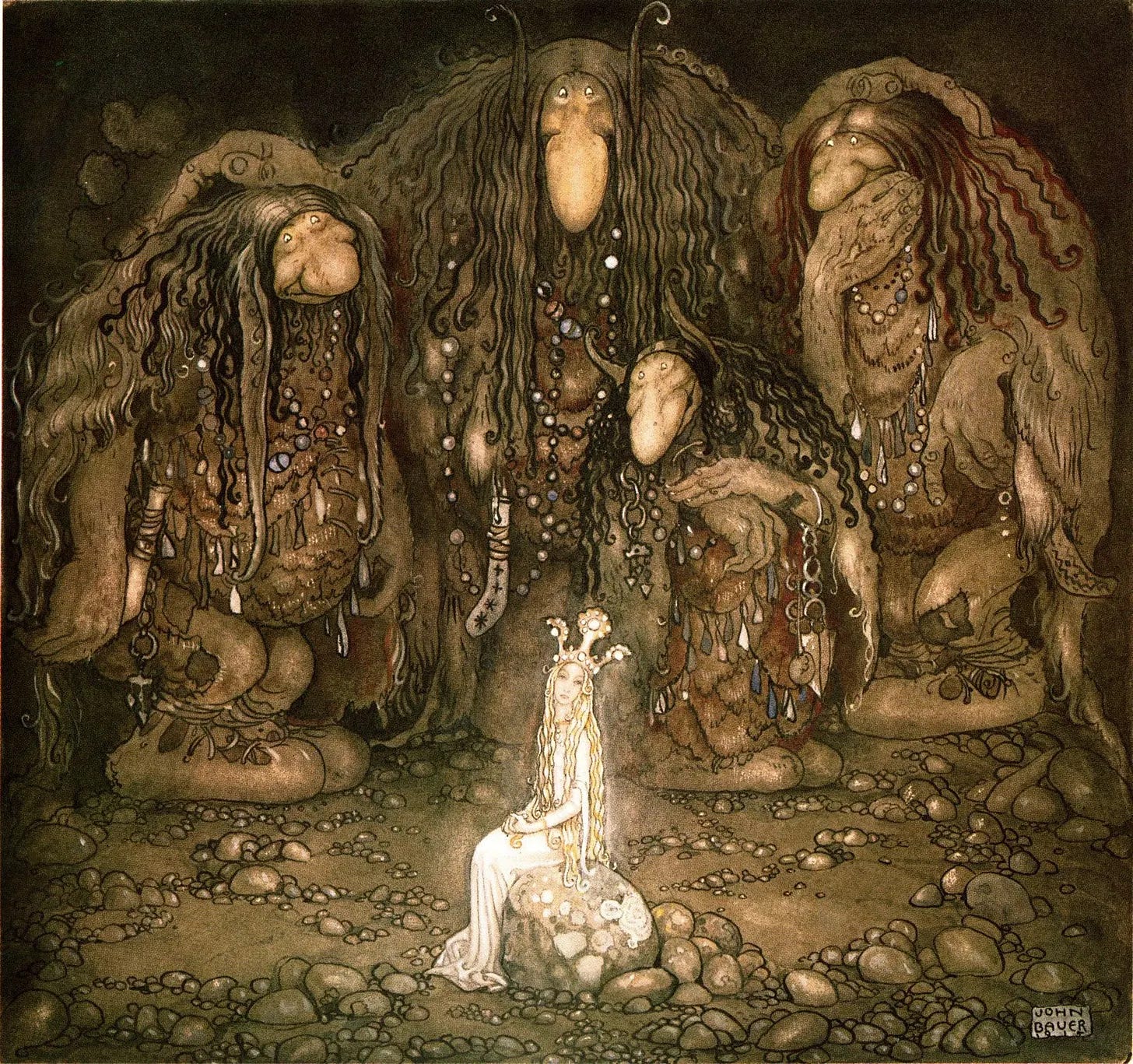
Look at them, troll mother said. Look at my sons! You won’t find more beautiful trolls on this side of the moon (1915) by John Bauer
I entered this rabbit hole with a simple question: is the Scottish Trow a local version of the more famous Norwegian Troll?
The folklore of the Orkney and Shetland archipelagos is a unique cultural intersection between Scandinavian and Scottish traditions. The traditional music here is unique; there are Selkies and Finfolk in the sea; and the Trow is omnipresent.
However, although the Trow may share some of its ancestry with the Trolls of Norwegian legend, it has evolved into something different, shaped by the unique geography, isolated history, and socio-religious climate of the Northern Isles, merging with other Scottish fairy beliefs along the way.
Nothing in this story is clear-cut, and even the word “trow” is opaque. It’s etymological roots are in Norn, an extinct North Germanic language spoken in Orkney and Shetland until the late eighteenth and nineteenth centuries. “Trow” is sufficiently similar to the Old Norse “Troll” for the link to be apparently clear, but there is a variant, Drow, a term that crops up in Orkney and Shetland dialects and was coined by novelist Sir Walter Scott in the nineteenth century. It might be more than a mere variant, deriving again via the Norn language from the Old Norse draugr, which is a different beastie altogether. In Norse mythology, the Draugr was the undead guardian of a burial mound – something like Tolkien’s Barrow Wights in The Lord of the Rings. Orkney and Shetland have no Norwegian-style mountains and fjords, so the Trows of the Northern Isles were reimagined as Draugr-like mound-dwellers (haugbúi), reflecting the land’s topographical and archaeological features.
The Troll’s relocation from towering mountains to an intimate landscape of hills and barrows resulted in downsizing from a giant to a subterranean goblin who only emerges after sunset. This nocturnal injunction links to the Norwegian tradition of Trolls turning to stone when exposed to sunlight. In Shetlandic lore, the nocturnal Trows hate the sun, but they are often merely trapped above ground if caught in its rays. Sometimes, however, they do indeed turn to stone like the Trolls in Norway (or the ones in Tolkien’s The Hobbit).
A Stranger In Your Country needs you! To receive new posts and support my work, consider becoming a free or paid subscriber.
This belief helped explain the islands’ numerous standing stones and megaliths. The stone circle on Fetlar, known as the “Haltadans” (the halting (i.e., limping) dance), is said to be a group of Trows and their fiddler who were so engrossed in their music that they failed to notice the dawn. The “limping” nature of the dance refers to the Trows’ clumsy, hopping gait. Many traditional Shetland fiddle tunes are said to have been learned directly from the Trows, with human fiddlers hearing the music drifting from hills and knowes and memorising the melodies.
Plants are part of Trow-lore, too. Ferns were known as “Trowie cairds” (a caird being a carding tool used to comb raw wool), and foxgloves were “Trowie glives” (and the word “foxglove” itself derives from “folk’s glove”, as in the little folk, i.e., the fairies). There are also several landmarks on the islands whose names reflect Trow ancestry.1
Earliest mentions of Trows
In the earliest descriptions, Trows are sea-dwellers. The first mention is in Joseph Ben’s Descriptio Insularum Orchadiarum, from the first half of the sixteenth century, a Latin text in which they are called Troicis or Trowis, seafaring inhabitants of the island of Stronsay. The maritime monsters resemble small male horses covered in seaweed and with huge genitalia. They were said to harass the women of the island, a narrative that aligns more closely with the predatory water-horses, Nuckelavee and Kelpie.
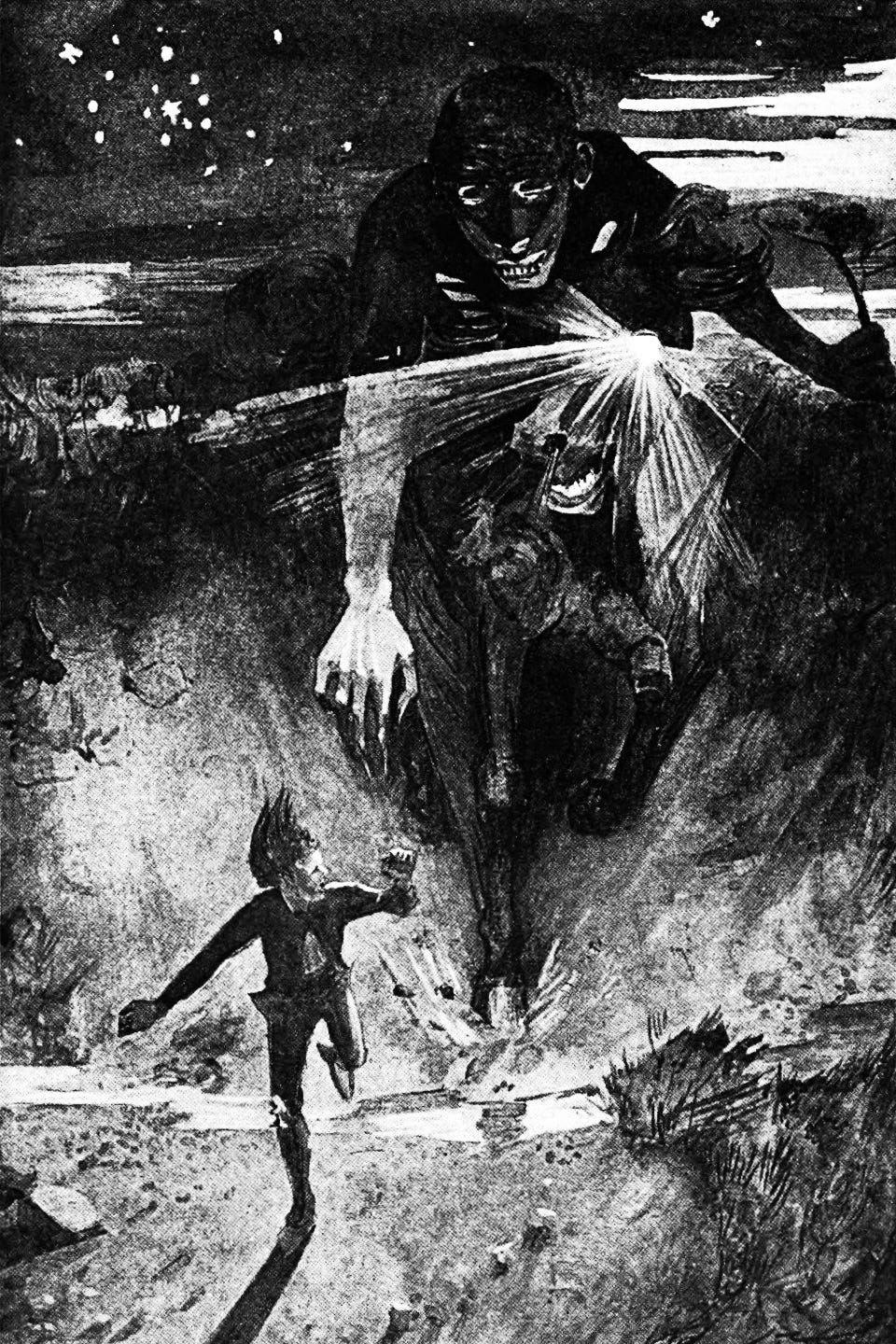
The Nuckelavee chasing an islander, painting by James Torrance (1859–1916).
So, the word “Trow” was in the local lexicon by the sixteenth century, albeit as a monstrous water horse. In the early seventeenth century, “Trow” appears in the records of the Scottish witch trials. The Court Book of Shetland (1615–1629) records cases of individuals accused of consorting with spirits, but although the word “Trow” is used, it is synonymous with the broader concept of “fairies”. In these documents, the supernatural entities are described as granting powers of healing or inflicting “elf-shot” on livestock.
In the eighteenth and early nineteenth centuries, more structured descriptions emerged. Samuel Hibbert, in his Description of the Shetland Islands (1822), provided one of the first comprehensive taxonomies of the Trow, noting their small stature, green clothing, and ability to make themselves invisible to ordinary mortals. Sir Walter Scott, in his Northern Isles-based novel The Pirates (1821), notes, rather confusingly,
The Drow or Trow, the Norwegian Troll, is a magician, or wizard, but more properly the Dwarf of the Scandinavian mythology.
Hibbert’s and Scott’s accounts, alongside those of other early nineteenth-century writers, suggest that by this period, the folkloric identity of the Trow had stabilised into three distinct groups: Land Trows (aka Drows or Hill Trows), Sea Trows (similar to the Finfolk of Orkney folklore), and the mythological Stone Trows of the standing stones.
The Land Trow
Physically, Land Trows are short, ugly, and misshapen, with grey or earth-coloured skin. Their physical oddities are often reflected in their names, such as Bannafeet, referring to feet shaped like bannocks (flat breads), or Truncherface, referring to a face as flat as a wooden trencher. This emphasis on ugliness and physical abnormality contrasts with the often ethereal and beautiful fairies of mainland Scottish or Gaelic tradition, but aligns with the famously ugly Scandi Trolls.
The Trows’ social structure is often described as a mirror of human society – aligning with the post-Catholic theories of Robert Kirk – with added supernatural elements. Within their hills, Trows live in halls decorated with gold and silver, feasting on the finest foods and wines. They have a complex social hierarchy, including a subspecies, the Kunal Trows (King Trows), who are exclusively male and, consequently, forced to seek mortal wives. They are only permitted one child, and the poor mortal mother invariably dies soon after the birth. This makes the Kunal Trow a melancholy creature.
The Stone Trow
The Trows of the stone circles are the stuff of mythology, but real ones may still be out there somewhere. In 1968, a man named Bill Traill entered the Dwarfie Stane on the Orkney island of Hoy and saw a small, gnarled, brownish figure emerge from the shadows of the stone chamber. The creature quickly vanished, leaving Traill convinced of the old legends of Trows inhabiting the site (the specific dweller here was Trolld the Dwarf, according to Walter Scott).
The sites listed in this article’s footnote equate to the Stone Trows - the kind of creature featured in the recent Troll movies.
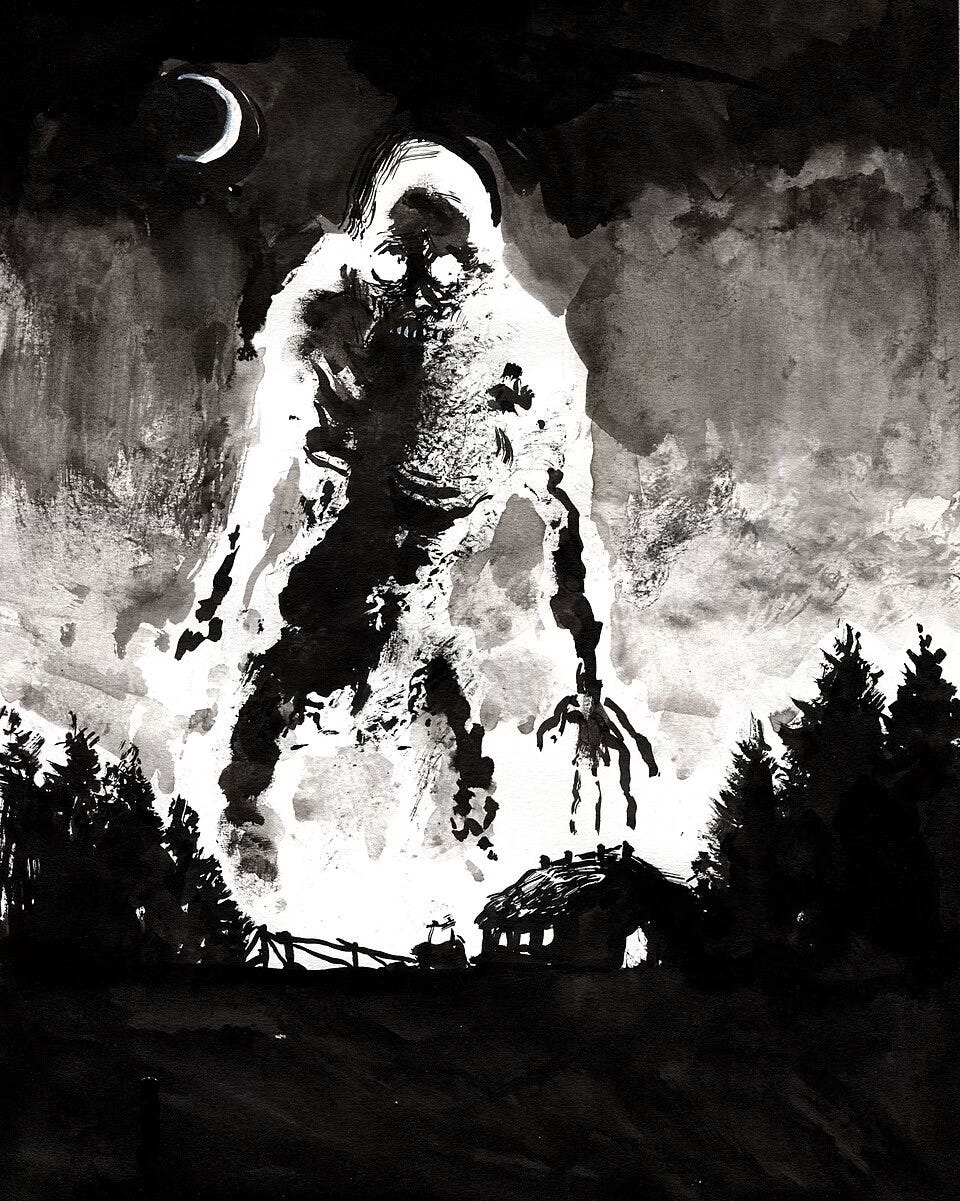
Giant draugr by Kim Diaz Holm. This file is licensed under the Creative Commons Attribution 4.0 International license.
The Sea-Trow
While the Land Trows occupied hills and mounds, the Sea Trows lurked in the waters surrounding Shetland and Orkney. According to some legends, they were originally Land Trows who were banished following a civil war. This wet exile led to physical adaptations: Sea Trows are described as “great rolling creatures” with scaly skin, seaweed for hair, and ungainly, waddling movements when on land.
Sea Trows occupy a folkloric space similar to the Selkies (seal-folk) and the Finmen, and are viewed with dread by fishermen. They tangle nets, steal fish from hooks, and capsize boats. In the 1770s, a tenant at Crawford Muir in Shetland was reported to have sacrificed a black lamb to the Sea Trows to ensure the success of a curse against his enemies. The church-based recorders of this incident in The Statistical Account of Scotland (1791–1799) were suitably unimpressed.
Sea Trows sometimes entered houses near the shore while the inhabitants were away, causing gentle mischief such as putting out the fire in the grain kiln or rearranging the furniture. One tale from Sandwick, recorded in John Spence’s Shetland Folk-Lore (1899) tells of a man who, fed up with these intrusions, hid under the straw in his barn and attacked the Trows with a flail when they entered to warm themselves by his kiln, an ambush that so shocked them that they never returned. It’s a striking paradox - while supernatural and feared, the Sea Trow was physically vulnerable and could be deterred by simple acts of human violence.
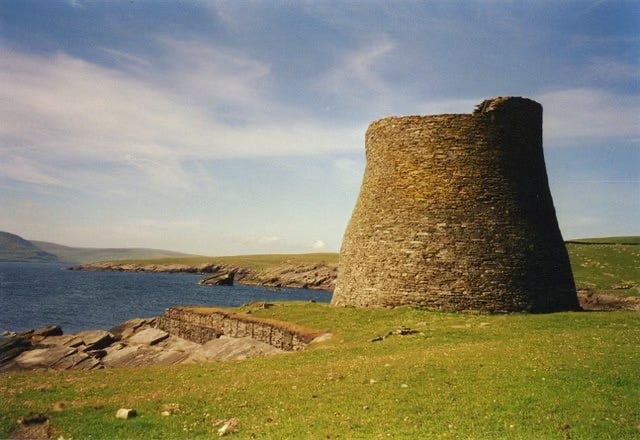
The Iron Age Broch by the sea-trow haunted shores of Mousa, Shetland. Tom Pennington / Mousa Broch / CC BY-SA 2.0
Trows in the nursery
Another common Trow narrative involves the “midwife of the mound”. In these tales – collected in the late nineteenth and early-twentieth centuries – a midwife is whisked away to an underground mound to assist a Trow-wife in labour. She is given a magical ointment to rub on the baby’s eyes, accidentally gets some in her own, and gains the “Second Sight”. Later, she sees the Trow in a public place (such as a market) and is blinded by him when he realizes she can see him. But we’re a long way from the Scandinavian Troll here, as these stories are told about fairies throughout the British Isles.
Again, like the fairies of the Scottish mainland, Trows were frequently blamed for “changelings”. If a healthy baby suddenly became sickly or behaved oddly, it was believed the Trows had stolen the real child and left an effigy or an elderly Trow in its place. The women were in danger, too – those in childbed were considered to be in “Trowie danger” and were never left unsupervised for fear they might be taken by Trows, with a dead effigy being left behind in their place. These beliefs provided a folk explanation for sudden infant death syndrome, children with Down’s Syndrome, and the all-too-common tragedy of maternal mortality.
There are also many tales of Trows in the role of the Brownie, a household spirit who clears up human mess and helps with work around the home and farm, but takes great offence and leaves in a huff if offered any gifts. By this stage, though, the Trow is so far removed from its Norse roots that I’ll nip this branch in the bud.
Methods to discourage Trows are simple and fairy-generic: they are deterred by iron and steel (so a knife or fork left in food would protect it), and they feared holy symbols, making the Bible, holy water, the crucifix, and the sign of the cross effective guards. During Yule (the Midwinter season), when Trows were believed to be at their most active and dangerous (this being the one time of year when they were allowed to spend all day outside their mounds), families would perform “saining” rituals, such as making straw crosses or carrying burning peats through the house to purify the space.
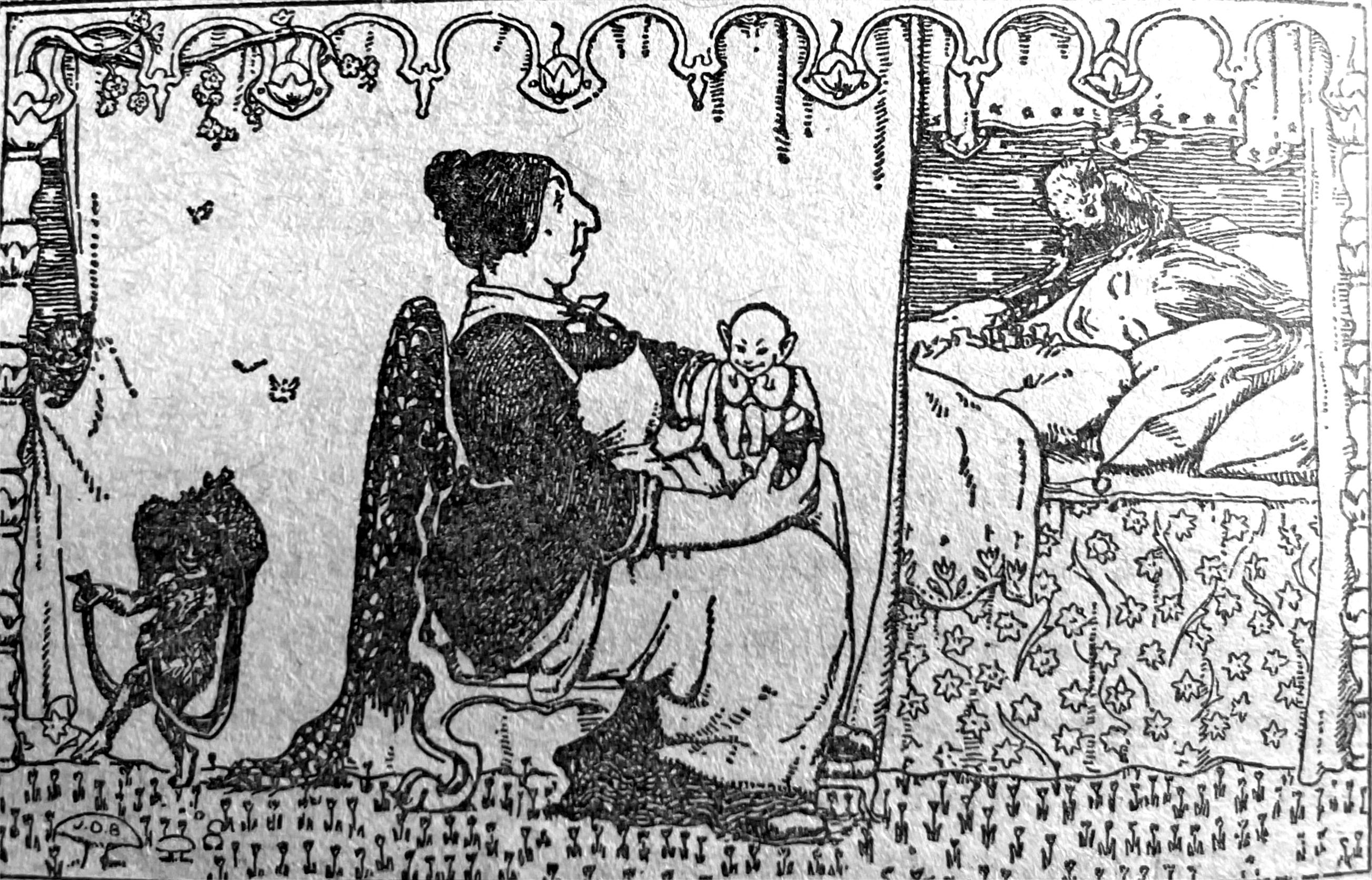
Midwife to the fairies/trows
The survival of the Trow
The Trows are said to have left the Northern Islands in the nineteenth century, driven out by nonconformist preachers. However, in the twenty-first century, they have returned in a new guise, becoming a symbol of regional identity and a staple of the heritage industry. Modern Shetland and Orkney culture has embraced the Trow as a mascot, distancing the creature from its formerly malign reputation. Trows appear regularly in children’s books, popular culture, and tourism materials. This modern incarnation is a far cry from the equine sexual predators described by Jo Ben or the hill-dwellers and child-stealers of the eighteenth century, but perhaps closer to the original indigenous Trow, the successor of the Norse Troll, unique to the northern islands.
However, this article’s key question remains – is the Trow a middle ground between the Scandinavian Troll and the Scottish fairy, or simply a Northern Isles name for the latter? The huge gap in the story certainly doesn’t help answer the question. The earliest literary appearance of Trows in Joseph Ben’s writings from 1529 or thereabouts is frustratingly late for a first mention, as the Northern Isles had been ruled by the Norwegians since the ninth century, and there were Scandinavian settlers there 200 years previously. The islands became part of Scotland in 1472, and yet the Trow only appears on the page in the sixteenth century.
Given the lack of evidence of a long Trow-as-Troll tradition, it seems likely that “Trow” was, for most people, simply a cognate of “fairy”, covering a broad range of beasties from Finfolk and barrow wights to brownies and hobgoblins. Apart from in Shetland, where they are, partly, the heirs of the Trolls, although the Troll connection is weaker than I had assumed when first researching this article.
Nevertheless, the Trow remains a unique entity in British folklore, a product of linguistic shifts, mythological hybridisation, and geographic isolation. It evolved from the grand, mountain-striding Trolls of Norway into a subterranean mound-dweller and sea creature that reflected the archaeological and geographical reality of the Northern Isles. But as a distinct species, the Trow-derived-from-Troll seems to be restricted to Shetland.
The Trow’s journey from Norway to the burial mounds of Shetland and the gift shops of the twenty-first century is, on the one hand, an impressive narrative of folkloric flexibility and cultural endurance. On the other hand, the notion of the Scottish Trow as a creature distinct from the British Fairy is more a semantic argument than an evidence-based one.
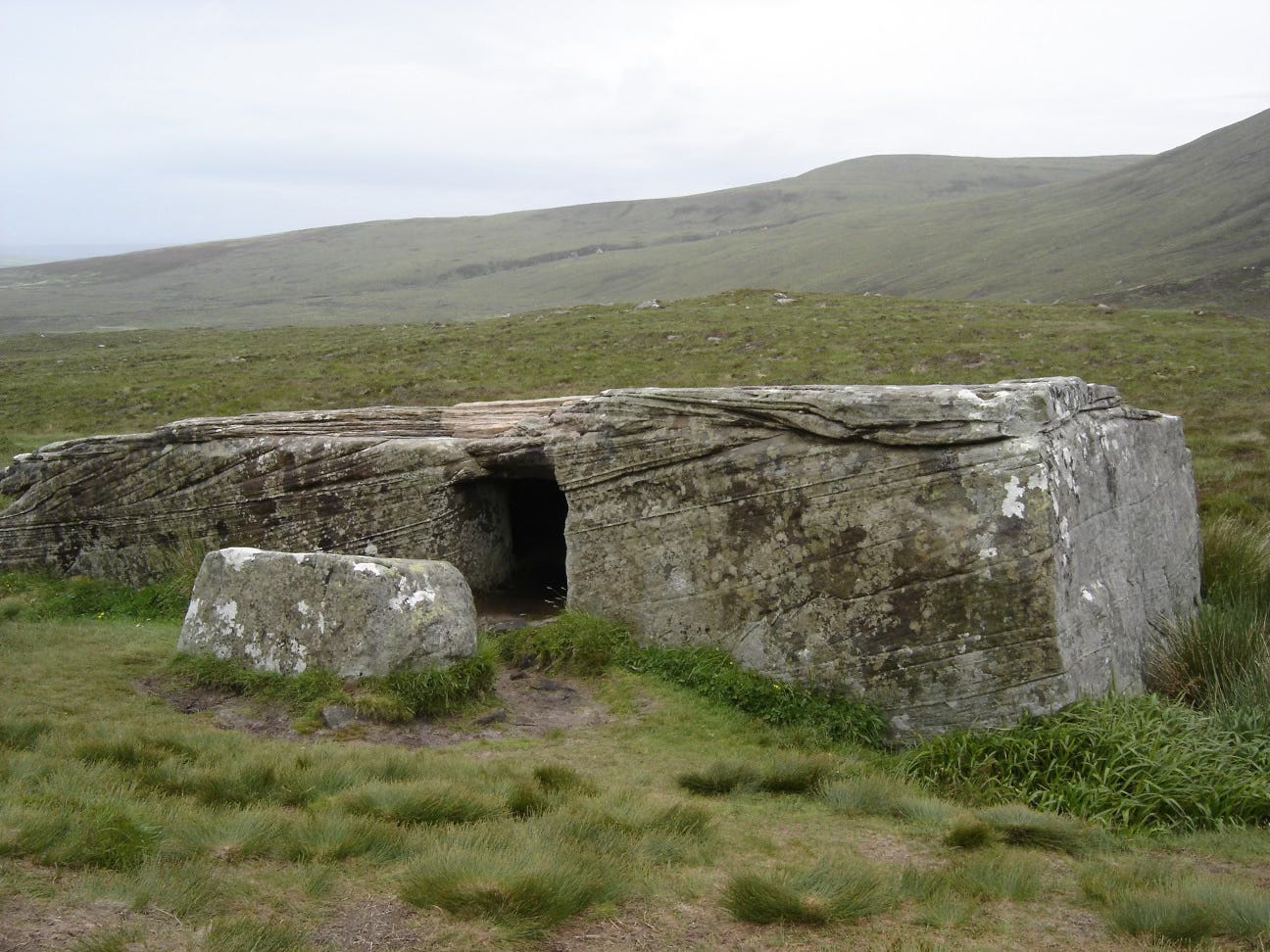
‘Dwarfie Stane’ (Dwarf’s Stone) on the Island of Hoy, Orkney Islands, Scotland. This file is licensed under the Creative Commons Attribution 3.0 Unported license. Attribution: Grovel at English Wikipedia
Sources
Ernest Marwick, The Folklore of Orkney and Shetland (1975)
Jessie Saxby, Shetland Traditional Lore (1932)
Katharine Briggs, A Dictionary of Fairies (1976)
https://en.wikipedia.org/wiki/Trow_(folklore)
https://shetlandwithlaurie.com/the-blog/shetland-folklore-series-trows
https://faeryfolklorist.blogspot.com/2015/10/the-trows-of-orkney-and-shetland.html
Shetland
Trollhoulland (Sandsting): The Troll-hill, a green mound associated with Trow music. The original underground band?
Trollkonastack (Northmavine): The Troll-wife’s Stack, a sea stack that was once home to a Trow.
Trolligart (Walls/Whiteness): The Troll’s Enclosure, a common name marking areas where Trows kept livestock.
Trollidale (Tingwall): A valley said to be a haunt for Trows.
Haltadans (Fetlar): The Limping Dance, a stone circle of Trows.
Orkney
The Dwarfie Stane: a Neolithic rock-cut tomb, said to be the home of a Trow called Trolld the Dwarf.
Trowie Glen (Hoy): A deep valley near the Dwarfie Stone.
Knowes of Trotty (Harray): A prehistoric barrow cemetery, “Trotty” being a corruption of Trow-tie (Trow-marsh).
Trowskerry: A sea rock associated with Sea-Trows.
The Trowie Knowe: A common name for dozens of burial mounds throughout the islands.
Once a week, get a library of unlimited free Sci-Fi, Fantasy, and Romantasy ebooks, and useful writing tips from Cecilia.
The best of Sci-Fi, Fantasy, and Romance, minus the clutter.
End of message. This is Cecilia Dart-Thornton, writing a new sci-fi romantasy series . . .
Thank you for this brilliant post, Paul!