
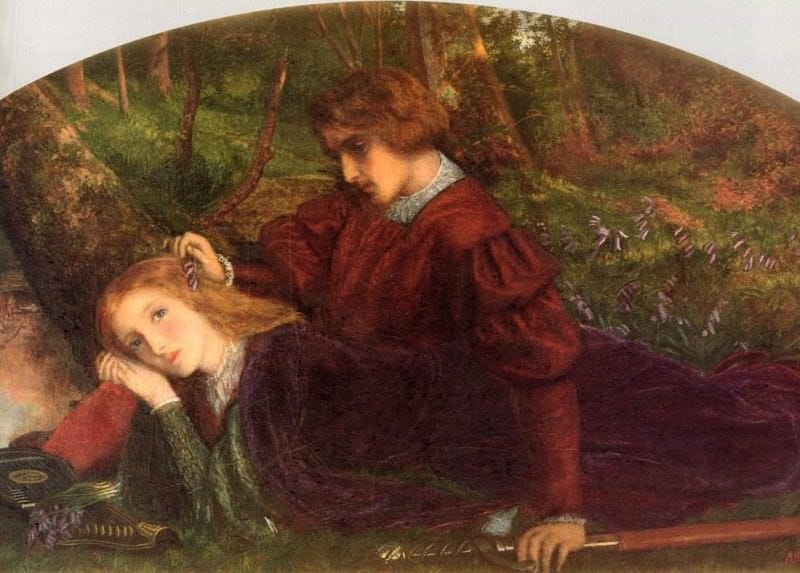
The Brave Geraint, by Arthur Hughes
Sain thee, my beloved subscribers. Here’s your weekly byte-sized newsletter from my Substack blog. Scroll down for:
Fresh Sci-fi & Fantasy News
Fortnightly Folklore Fix
Free eBooks

Click the button to browse free unlimited fantasy, romance, romantasy & sci-fi.
NOTE: These offerings change from week to week. Some disappear, and new ones take their place. Check them out so you don’t miss anything!
✨✨🌟📙📘📗 📚 📚📖 📜🪶📖📚📚 📗 📘📙🌟✨✨
Fresh Sci-fi & Fantasy News
Presented for your entertainment, without endorsement or judgement. 😃
📚 Books & Publishing
Sci-fi
“The Hunger of Those Who Built It” by Wendy Waring, a novel about climate change is published today, 15 September.
At Dragon Con, the 2026 Dragon Award for Best Science Fiction Novel was awarded to "Operation Bounce House” by Matt Dinniman. (Daily Dragon)
Fantasy
Also today, “Godstorm”, by Solitaire Townsend, is published. You’ll love it if you’re a fan of the Roman Empire. And who isn’t? 😃 (Simon & Schuster)
Back to Dragon Con . . . Jim Butcher’s “Twelve Months” won the Dragon Award for Best Fantasy Novel. (Daily Dragon)
Another award presented at Dragon Con was the 2026 Eugie Foster Memorial Award for Short Fiction. This went to A.C. Wise’s “Wolf Moon, Antler Moon”. (Rochester Speculative Lit Assoc)
Romantasy
Romantasy releases this week were more numerous than magical swords with suspiciously specific prophecies attached. According to Romantasy Order, new titles included:
Victoria Aveyard’s “The Lyrian Sea, Book #1 in her pirate fantasy romance series “Tempest”
L.J. Claren’s “The Incendiary”, Book#2 of “The Selvaren”
Lucy Jane Wood’s standalone novel “Disenchanted”
“The Wolf Queen” by Lauren Palphreyman
Penn Cole’s novel “Burn of the Everflame”
“Crown of Crimson and Crows” by Tessa Hale
Jasmine Mas’s “The Emperor’s Enemy”, Book #1 of the “Unsurvivable Love Duet”
🎬 Film & TV
Sci-fi
As we all know, “Doctor Who” production has been paused. Producer Jane Tranter says she expects the series to remain based in 🏴Wales🏴 when filming resumes. What this isn’t is a new-season confirmation. (Radio Times)
Romantasy
Yes, we all wish The Bitterbynde Trilogy could be adapted for screen, but that’s only going to happen when I get three million subscribers. Only 2,999,793 to go. Kristen Ciccarelli, on the other hand, is having her “Crimson Moth” books developed for TV. (Deadline). Ciccarelli’s series has sold more than a million copies in the US and Canada. (Podcast Rex)
Fantasy
And in the Dragon Awards, HBO’s “A Knight of the Seven Kingdoms” won Best Science Fiction or Fantasy TV Series. “Project Hail Mary” won Best Science Fiction or Fantasy Movie. (Daily Dragon)
🎧 Audio & Radio
Sci-fi
Big Finish released “Dark Gallifrey: The Decayed Master Part 3” on 10 September. They also announced two new “Doctor Who” seasonal audio collections; a Halloween box set and a Christmas one. (Big Finish Productions)
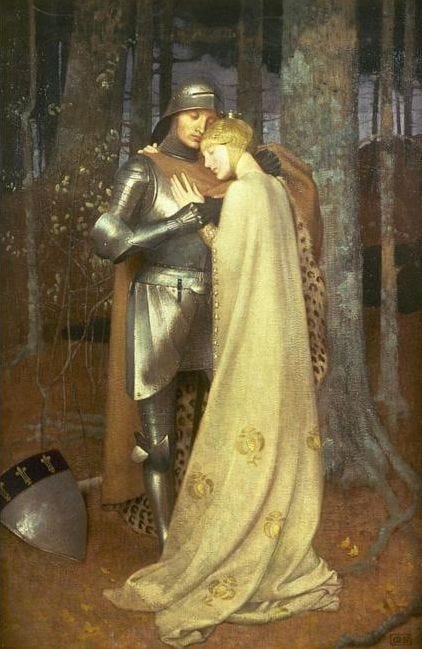
Marianne Stokes: Aucassin and Nicolette
Fortnightly Folklore Fix:
Don’t worry, beloved subscribers—you’ll still receive Writing Tips in this newsletter, only now they’ll arrive every fortnight instead of every week. After the results of last week’s poll, Writing Tips will alternate with articles about Folklore (which includes fantasy & romantasy). This week we’re starting with that gorgeous Scottish ballad whose magical events take place in a Real World location: Tam Lin.
Tam Lin
My first encounter with the folklore character Tam Lin happened years ago, when I fell in love with the music of Fairport Convention.
My folk-crazy sisters and I managed to get hold of their 1969 album Liege & Lief. We played the eight tracks over and over, singing in harmony, and incidentally learning many of the songs by heart. Later I played them when I joined a couple of folk music bands. My favourites included Matty Groves, The Deserter, and Tam Lin.
I love the melody of Tam Lin. It’s in a minor key, which always recommends any melody to me. But the lively and evocative lyrics are inspiring, and somehow they feel true to “authentic” folklore.
The Ballad
They tell of the young noblewoman Janet, whose father bans her from going anywhere near a place called Carterhaugh.
I forbid you maidens all that wear gold in your hair
To travel to Carterhaugh, for young Tam Lin is there.
Carterhaugh is a historic wood and farm near the confluence of the Yarrow Water and the Ettrick Water near Selkirk in the Scottish Borders. This real location shares its name with the fictional setting for the meeting between Tam Lin and Janet in the ballad "Tam Lin". This is commemorated in the name of Tamlane's Well, on the roadside outside Carterhaugh Farm. [Wikipedia]
The magical, folkloric version of Carterhaugh Wood must have been embowered with a profusion of roses. Roses are mentioned in the lyrics, and they are laden with romantic significance, so I imagine the place as a riot of flowering briars, much like the thicket that surrounds the castle of the Sleeping Beauty.
Against the wishes of her father Janet goes to Carterhaugh — ostensibly to pick some of the famous and spectacular roses. She tucks her kirtle “a bit above her knee”. This may have been to avoid entanglement with thorns, but more likely it was to do with the real reason she disobeyed her father.
You see, Carterhaugh was the haunt of the young knight Tam Lin. So handsome was he, that the Faerie Queen had stolen him for her own, binding him with enchantment, so that he could not cross the boundaries of Carterhaugh back into the world of mortals. The wood, and the roses, were his, for the Faerie Queen set him there as the guardian of the flowers.
He was trapped, but that did not stop him stealing the hearts of damsels who happened to stray into the rose-filled wood; this was the reason why all good fathers prohibited their daughters from venturing near the place.
None that go by Carterhaugh but they leave him a pledge,
Either their mantles of green or else their maidenhead.
Headstrong teenager Janet has her own ideas, however. Perhaps she had once glimpsed him, and fallen in love at first sight. Perhaps she was inquisitive, and wanted to see the famous knight for herself. Or perhaps she just wanted to rebel.
Whatever the reason, she skips away when her father’s back is turned and heads for the woods.
Janet tied her kirtle green a bit above her knee,
And she’s gone to Carterhaugh as fast as go can she.
In the wood, she rashly starts picking roses while, no doubt, keeping watch for the renowned knight, knowing the act of stealing the flowers would summon him. Predictably, pretty soon Tam Lin appears.
She’d not pulled a double rose, a rose but only two,
When up then came young Tam Lin, says “Lady, pull no more!”
“And why come you to Carterhaugh without command from me?”
“I’ll come and go”, young Janet said, “and ask no leave of thee.”
You’ve got to hand it to Janet. She knew her own mind and was not afraid to stand up for herself. The song does not go into details, and we don’t know how many times Janet visited the woods, but we do know that when she returned from that first visit she still had her green kirtle. . .
Janet falls in love with Tam Lin, conceives a child, and refuses to let her father arrange a respectable match with someone else.
Janet tied her kirtle green a bit above her knee,
And she’s gone to her father as fast as go can she.
Well, up then spoke her father dear and he spoke meek and mild.
“Oh, and alas, Janet,” he said, “I think you go with child!”
“Well, if that be so,” Janet said, “myself shall bear the blame!
There’s not a knight in all your hall shall get the baby’s name.”
For if my love were an earthly knight as he is an elfin grey,
I’d not change my own true love for any knight you have.”
Note: “Elfin grey”, apparently, describes someone who has lost their mortal, earthly status and been taken into the shadowy domain of the faerie realm. As this is a Scottish ballad, the word “have” at the end of the next line was probably pronounced “ha’e”, which would make it rhyme with “grey”.
Janet does not want to marry any mortal man. Tam Lin is her true love, but he is trapped in Faerie. She returns to Carterhaugh and asks him (belatedly, in my opinion) why he stays there. He explains he’s been enslaved by the Faerie Queen. She saved his life, and in return she claimed him as her own.
Janet tied her kirtle green a bit above her knee
And she’s gone to Carterhaugh as fast as go can she
“Oh, tell to me, Tam Lin,” she said, “why came you here to dwell?”
“The Queen of Faeries caught me when from my horse I fell
There’s an added problem for Tam Lin. Every seven years the Faerie Queen pays a tithe (a kind of tax) to Hell. Because of his physical perfection, he’s pretty certain that the next tithe is going to be him.
And at the end of seven years she pays a tithe to Hell.
I, so fair and full of flesh, am feared it be myself.
The young knight wants to avoid being sacrificed, and Janet wants to give her baby a father, so they work out a plan together. Luckily, Tam Lin knows exactly what it would take to tear him from the Faery Queen's clutches, but he warns Janet that it’s going to take a tremendous amount of grit on her part.
He explains:
But tonight is Hallowe’en and the Faerie Court ride.
Those that would their true love win at Miles Cross they must bide.
First let past the horses black and then let past the brown.
Quickly run to the white steed and pull the rider down.
For I’ll ride on the white steed, the nearest to the town,
For I was an earthly knight, they give me that renown.
Oh, they will turn me in your arms to a newt or a snake,
But hold me tight and fear not, I am your baby’s father.
And they will turn me in your arms into a lion bold,
But hold me tight and fear not and you will love your child.
And they will turn me in your arms into a naked knight,
But cloak me in your mantle and keep me out of sight.”
We already know Janet is plucky and resourceful. Let’s see if she can endure the ordeal! Imagine her on the night of October 31, concealed among the bushes beside the crossroads. The sky is sprinkled with stars, and at midnight she hears the chime of bridle bells. The Faerie Court rides by in procession, mounted on splendid steeds, and clad in rich garments. The black horses pass, and the brown, Then she spies a pale glimmer.
Here’s a quote from The Bitterbynde Book 2: The Lady of the Sorrows, describing such a procession:
Late after middle-night she was still awake when she heard at last a heart-stopping sound; the crystal chime of a bridle-bell. Then it seemed to her that the wind lifted her suddenly and swung her against the night sky. The jingling approached like the spangle of sequins, like a woodland of silver bell-flowers rustled by a Summer-silk breeze.
Seen indistinctly in the star-watered gloaming between the apple orchard’s fretted boughs, a procession of seven score riders was slowly passing by.
A Faêran Rade.
Breathtakingly fair were they, with a shining beauty that was not of Erith. All were arrayed in splendid raiment of green and gold, and mounted on magnificently caparisoned steeds whose bridles glittered with tiny bells, like chains of stars. The knights among them wore golden helmets. Clasped about their limbs were finely chased greaves. Some bore in their hands golden spears like shafts of pale sunlight. To see these riders was startling, like a first glimpse of new blossom in Spring—a sudden enchantment glimmering against boughs that lately stretched stark and black.
To see them was to truly awaken, for the first time.
In the middle of the night she heard the bridle ring.
She heeded what he did say, and young Tam Lin did win.
Brave Janet holds on while the Queen transforms her lover into terrifying forms such as a squirming snake and a ferocious lion, to force her to let go. In other versions of the song the young knight also becomes a bear, a red-hot iron bar, and a burning coal. Janet refuses to let go, in spite of the pain.
She breaks the spell with her fearlessness and determination. He lies in her arms, probably half-insensible after those rigorous metamorphoses, and she promptly covers him up with her mantle, screening the rescuee from the view of the faeries. (This tale would make a wonderful movie!)
The story is not over, nonetheless. The Faerie Queen is none too pleased, and she curses Janet. Indeed, the faeries of folklore are not like the tiny, innocent creatures pictured in Cicely Mary Barker’s classic ‘“flower fairies” books!
Then up spoke the Faerie Queen, an angry queen was she!
“Woe betide her ill-fa’oured face, an ill death may she die”
“Oh, had I known, Tam Lin,” she said, “what this night I did see,
I’d have looked him in the eyes and turned him to a tree”
Note: Ill-fa’oured = “ill-favoured”, i.e. ugly. “Ill-fa’oured” is the Scottish pronunciation.
Tam Lin in The Bitterbynde
Tam Lin’s story made such an impression on me that it wove its way into my fantasy trilogy, The Bitterbynde. Tam Lin makes an appearance as a character in the epic saga. I changed his name to Tamlain and gave him a string of appropriate titles. He enters the narrative several years after the events of his song take place. Here’s where he first appears, in The Battle of Evernight:
Somewhere within the vitals of that keep, Tamlain Conmor, the Most Noble the Duke of Roxburgh, Marquess of Carterhaugh, Earl of Miles Cross, Baron Oakington-Hawbridge, and Lord High Field-Marshal of the Dainnan—to name only his principal titles—strode into the richly furnished suite he always occupied when at Court, calling for his junior valet and his squire.
Later, there’s a more detailed description:
Conmor, Duke of Roxburgh, stood by the window. He was still in the field-dress he had worn that day: loose-sleeved shirt, leather doublet slit to the hips, belted loosely at the waist, embossed baldric slung across the shoulder, suede leggings, and knee-boots. Firelight burnished his shoulder-length, unbound locks to dark mahogany.
Tam Lin: Themes and Cultural Significance
The Scottish border ballad of Tam Lin dates back to at least 1549. Unlike many traditional tales where women need to be rescued, the story involves a mortal woman — Janet — who risks her life to break a spell that binds her lover.
This story stands out in folklore due to the active agency of Janet, who demonstrates bravery, endurance, and decisive action. Her willingness to hold fast despite physical pain directly mirrors ancient Celtic concepts of true devotion overcoming dark magic.
Other fantasy authors have drawn on this ballad’s underlying psychological, emotional, and mythic themes; notably Diana Wynne Jones with Fire and Hemlock (1984), in which she interweaves Tam Lin with the ballad Thomas the Rhymer; Susan Cooper’s Tam Lin (1991), a beautifully detailed picture book retelling; and Patricia A. McKillip’s Winter Rose (1996) in which the author uses the ballad’s structure to craft a lyrical, dreamlike story about obsession and sacrifice.
Other Mortals Stolen Away by the Faeries
Tam Lin and Thomas the Rhymer are the most famous named mortals who have been whisked away to Faerie and trapped there, but the folklore of every part of the world includes similar tropes.
Celtic folklore has Oisín (Ossian), a legendary warrior of the Irish Fianna. A fairy woman named Niamh of the Golden Hair fell in love with him and transported him across the sea on a white horse to Tír na nÓg (the Land of Youth). He lived there in luxury for what felt like three years, but when he returned home, he discovered three centuries had passed. Upon touching mortal soil, he aged instantly.
The Japanese folktale of Urashima Taro is imprinted in my mind because it was among a book of folktales for children that occupied the bookshelves of my childhood home. It is very similar to Oisín’s tale, except that Urashima Taro travels to a magical land beneath the sea with his faerie lover, riding on the back of a giant turtle. After what seems like a short time he returns home for a visit, but before he leaves the faerie woman gives him an ornate casket, advising, “Do not open it, for if you do you may never return to the realm beneath the waves.” When he gets home he finds he’s been away for centuries and everyone he used to know has passed away. In grief, he opens the box, and crumbles to dust. As a child, every time I read it I’d tell him not to open it. . .
There’s also the British King Herla, the Welsh Taliessin and Kilhwch (Culhwch), and the Scottish Rev. Robert Kirk. . . I could say more about them, but this post is long enough. Beyond these named figures, entire broad categories of mortals appear to have been routinely abducted into Faerie; notably new mothers, wet nurses, musicians and bards — so if that’s you, watch out!
Beloved Subscribers: I only send you one post per week, because I respect your email inbox. However, I write other stuff, which you can read on the Substack website and app.
Once a week, get a library of unlimited free Sci-Fi, Fantasy, and Romantasy ebooks, and useful writing tips from Cecilia.
The best of Sci-Fi, Fantasy, and Romance, minus the clutter.
End of message.
This is Cecilia Dart-Thornton, writing a new sci-fi romantasy series . . .
It’s a fantastic story, surely one of the jewels in the crown of British folklore. There’s a lot more detail in the original Child Ballad, a version compiled by none other than Sir Walter Scott (and, therefore, probably augmented, as he was wont to do). I also wonder if you, or any of your subscribers, have seen the 1970 movie The Ballad of Tam Lin (aka Tam Lin, or The Devil’s Widow), a 60s-set story loosely based on the ballad. It’s a fascinating oddity, not at all what you would expect from the title, and not exactly what you would call a classic - but it has a great version (unreleased?) of the ballad on the soundtrack by the mighty Pentangle.