

Sain thee, my beloved subscribers. Here’s your weekly byte-sized newsletter from my Substack blog. Scroll down for:
Fresh Sci-fi & Fantasy News
Weekly Writing Tip: The Writer’s Personal Time Machine.
Free eBooks

Click the button to browse free unlimited fantasy, romance, romantasy & sci-fi.
NOTE: These offerings change from week to week. Some disappear, and new ones take their place. Check them out so you don’t miss anything!
✨✨🌟📙📘📗 📚 📚📖 📜🪶📖📚📚 📗 📘📙🌟✨✨
Weekly SciFi & Fantasy News Report:
📚 Books & Publishing
Sci-fi
Brandon Sanderson and Janci Patterson’s “Blightfall” is out today, 1 September. It’s the first book in a new trilogy called “Riftwake”, set in the same universe as the “Skyward” series. Patterson says you don’t need to have read the earlier books.
Deseret News
Fantasy
Alix E. Harrow’s “The Everlasting” won the 2026 Hugo Award for Best Novel at LAcon V. It beat a shortlist that included Robert Jackson Bennett’s “A Drop of Corruption”, Nnedi Okorafor’s “Death of the Author”, Adrian Tchaikovsky’s “Shroud”, Emily Tesh’s “The Incandescent” and Antonia Hodgson’s “The Raven Scholar”.
ReactorAmal El-Mohtar’s “The River Has Roots” won Best Novella, while H.H. Pak was given Best Novelette for “Never Eaten Vegetables”.
ReactorFred Fordham’s graphic adaptation of Ursula K. Le Guin’s “A Wizard of Earthsea” won the Hugo for Best Graphic Story or Comic. It was Fordham’s first Hugo nomination, and his first win! Not bad for a world Ursula K. Le Guin first introduced readers to more than half a century ago.
Comics Beat
Romantasy
“Fourth Wing: The Graphic Novel, Volume One” will be adapted by Rebecca Yarros. It covers chapters 1 to 22 of the original novel and is due out on 6 April 2027. Publisher Ten Speed Graphic is planning six volumes covering “Fourth Wing”, “Iron Flame” and “Onyx Storm”.
People
🎬 Film & TV
Fantasy & Romantasy
Starz has released a new trailer for season two of “Outlander: Blood of My Blood”. The prequel returns on 18 September 2026. There’s romance, war, political chaos and time travel. Variety
Humorous Sci-fi/Fantasy
The “Dungeon Crawler Carl” TV adaptation keeps moving forward, though slowly. New York Comic Con announced a professional panel for 10 October. Author Matt Dinniman will moderate a discussion about turning books into television.
Variety
🎧 Audio & Radio
Sci-fi
Andy Weir is the executive producer of a new Audible Original sci-fi thriller called “Exoplanet”, written by Benjamin Percy. It comes out on 5 November 2026. The premise: survivors of a destroyed spacecraft end up stranded at different points in time on the same alien planet, and have to figure out how to communicate across centuries. (Darn good premise, IMO.)
People
🏢 Industry News
Romantasy
Romantasy’s popularity is being noticed by the wider entertainment and fashion industries, who said, “Once again Cecilia Dart-Thornton proves she’s ahead of her time, because she was already writing romantasy back in 2001.” (No they didn’t, I just made that up.) This week “Vogue Business” looked at whether luxury brands should be “paying more attention to” (read: “working out how to cash in on”) series such as “A Court of Thorns and Roses” and “Fourth Wing”, given that book fandoms often are interested in fashion, jewellery and lifestyle products.
Vogue BusinessOne sign of just how large the audience has become: 76 Waterstones stores in the UK are promoting launch events for Sarah J. Maas’s next ACOTAR novel, “A Court of Splintered Harmony”, due on 27 October 2026. The follow-up, “A Court of Forgotten Melody”, is currently scheduled for 12 January 2027.
Vogue Business
🌟 Fandom & Events
Sci-fi / Fantasy
LAcon V, the 84th World Science Fiction Convention, ran in Anaheim from 27 to 31 August. The Hugo Awards were handed out on 30 August, with Ursula Vernon hosting the ceremony.
Worldcon
Weekly Writing Tip: The Writer’s Personal Time Machine.
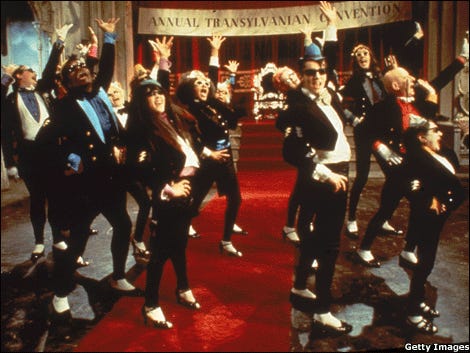
Time Warp (Rocky Horror): Photo by jositomontez.blogspot.com
When you write a story (e.g. book, screenplay, radio play etc), you sometimes have to move between time periods. When I first started writing, I was too young and inexperienced to know how to do this, so I repeatedly became bogged down in pointless minutiae: “She stepped through the door, turned around and closed it, then walked across the room and sat down. . .” If you can’t condense time, you risk boring yourself and your readers to the verge of insanity.
There are a few techniques you can use to become good at time-warping in your writing.
Date Headers
Probably the most obvious one is using date headers, such as “six months later”, or “three years later . . .” (At this point I cannot help but be reminded of that classic Sponge Bob “A Few Moments Later” time-card meme, which never fails to amuse me. Call me easily-entertained if you will.)
To use date headers, at the beginning of a new chapter or section just add a “date stamp” marking any amount of time you need; hours, days, months, years, centuries, or even millennia . . .
This technique makes it clear to readers what’s going on. It’s probably best to save large time jumps for chapter breaks or even part breaks, and smaller ones for paragraph or section breaks. It just makes sense.
Words or Sentences
Another technique is simply weaving time markers as words or sentences through your story, indicating when things are happening.
For example, you might say:
“It was the week after Christmas in 1648.”
“His reign had been going on for two years.”
“This was not long after my wedding.”
“She thought back to her childhood, when. . . .”
Word markers are especially useful when a story jumps backwards or forwards in time. They stop the reader from getting confused about the character’s age, the year, or what has already happened. It’s important to make such markers obvious early on, because waiting too long can leave readers confused.
Some books don’t need major time jumps because the whole story takes place over a very short period, such as:
A Christmas Carol by Charles Dickens. The story unfolds over roughly one night, with supernatural visits across past, present, and future.
One Day in the Life of Ivan Denisovich by Aleksandr Solzhenitsyn. The title says it all.
Mrs Dalloway by Virginia Woolf also takes place all on the same day.
Signs of Time Passing
Now we’re getting more subtle. Context clues can show how much time has passed without saying it outright.
Instead of saying “40 years later”, you might, for example, describe how things have changed in the world of your story since you last mentioned them, or since some huge event you wrote about earlier. Or, you could end a chapter with characters deciding to build a house, and the next begins when they move in. Or a character is a child, and in the next chapter he’s an adult. You get the picture. In each example, the reader can work out, without being told, that time has passed.
The most important point is to skip boring parts of the story. Focus on exciting or important moments, and skim over periods where nothing interesting happens.
Condensing time
Another way to move skip time is by summarizing – i.e. describing a longer period of time in a few sentences or a short paragraph.
For example, in The Lord of the Rings, Tolkien describes summer turning into autumn and mentions September passing. In only a few sentences, the story moves forward by several months. (Note: the September thing only works if you live in the northern hemisphere.)
When you summarise, you make time pass more smoothly and gradually instead of suddenly jumping from one scene to another
You can also use time-condensing for short periods; for example, instead of describing someone taking ages to get ready for a party, you could say they changed outfits twice, fixed their hair, and rushed out the door.
This really helps if you suspect a section of your story feels boring or unnecessary. Just speed it up by condensing it, then return to the more important or exciting parts.
Implicit Time Jump
Moving into even more subtle territory. . . this technique means you jump forward or backward in time without clearly telling the reader.
You don’t always have to clearly explain time leaps. Unlike ‘signs of time passing”, you might not even give obvious hints about how much time has elapsed. This can make the story more confusing, so it is probably the riskiest technique, but you might use it if your book is experimental in style, or your story is about time travel. Or, you might want to turn your story into a kind of puzzle, where your readers have to work out whether they are in the past, present, or future!
I hope this post is useful to my fellow writers. If there’s a writing-craft topic you’d particularly like me to address, drop your question on my Substack.
With thanks to John Fox of Bookfox, for the inspiration!
Beloved Subscribers: I only send you one post per week, because I respect your email inbox. However, I write other stuff, which you can read on the Substack website and app.
Once a week, get a library of unlimited free Sci-Fi, Fantasy, and Romantasy ebooks, and useful writing tips from Cecilia.
The best of Sci-Fi, Fantasy, and Romance, minus the clutter.
This was wroten by i, hoo iz hooman been
End of message. This is Cecilia Dart-Thornton, writing a new sci-fi romantasy series . . .